
OC Maker, Step by Step: Create an Original Character with Portraits, Full Lore, and a Story to Live
Most OC makers stop at a picture. This step-by-step guide shows how to use LiveTale as an OC maker that goes all the way: design your original character, generate stylistic illustrations, write their world's full lore, and then actually roleplay their story, scene by illustrated scene.
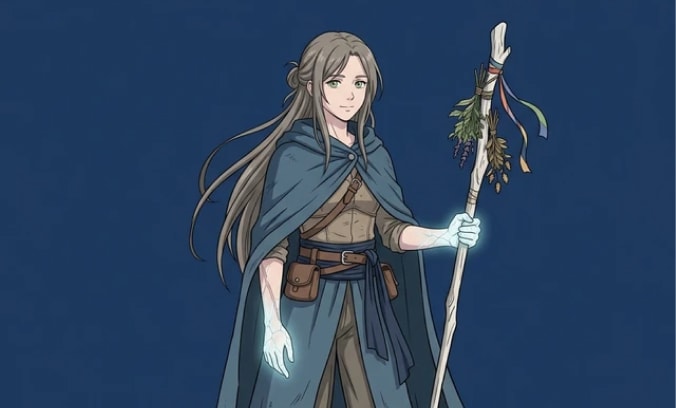
Most OC makers give you a picture. A picker for hair, eyes, and outfit, an export button, and that is the end: your original character exists, but they have nowhere to go. LiveTale is an OC maker with a story engine behind it. You design your character, give them a face in a consistent art style, write the lore of their world, and then step into scene one and play. This guide walks through the whole process, step by step.
What makes an OC maker worth using
If you create original characters, you already know the itch. The character in your head has a look, a history, a voice, and a world they belong to. A portrait generator captures one of those. A character sheet template captures another. What almost nothing captures is the part that made you invent them in the first place: the stories they belong in.
Here is what the full loop looks like in LiveTale:
- Design your OC: concept, looks, drives (Steps 1 to 3)
- Give them a face with generated illustrations, or your own art (Step 4)
- Add light stats so dice can test them fairly (Step 5)
- Write their world's lore, with portraits for their supporting cast (Step 6)
- Roleplay their story, illustrated scene by scene (Step 7)
The character creation itself takes about five minutes. The lore can take as long as you love spending on it.
Step 1: Name and concept
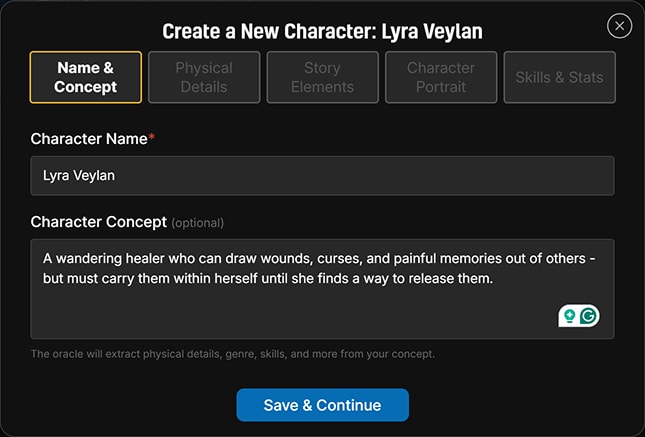
Pick a genre first: High Fantasy, Cyberpunk, Superheroes, Slice of Life, Romance, or any of the two dozen worlds LiveTale offers. The genre shapes everything downstream, from the skills the game suggests to the way your scenes look and sound. If your OC already exists in your head, pick the genre that matches their home world.
Then give them a name and a concept: one or two sentences about who they are. "A disgraced knight seeking redemption" works. So does "a cheerful street chef who hears ghosts." Two tips that pay off later:
- Be specific. "A warrior" gives the AI storyteller little to work with. "A retired war hero hiding from an old oath" plants story seeds the narrator will actually harvest.
- Keep a flaw or tension in the concept. The OCs that come alive in play are the ones with something unresolved built in.
Step 2: Their look
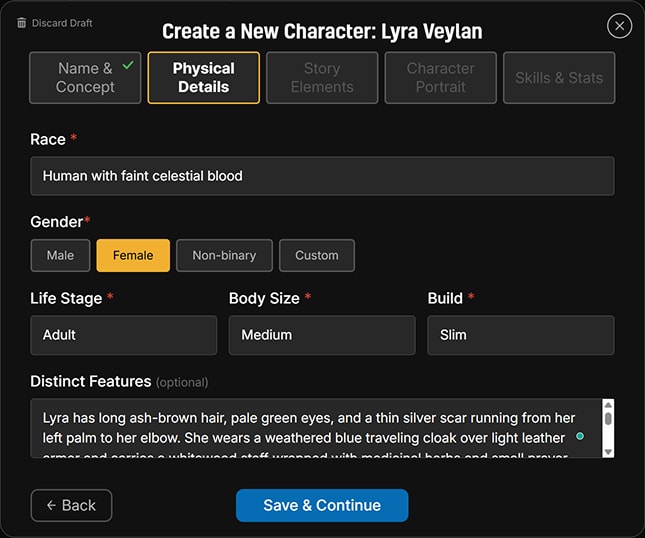
Now describe your character's appearance: race, gender, life stage, body size, and build, plus a field for distinct features like scars, tattoos, heterochromia, or that one earring with a story behind it. Select from suggestions or type your own.
These details do double duty. The storyteller weaves them into the narration ("the innkeeper eyes the scar over your brow"), and the illustration pipeline uses them to draw your OC consistently in every scene image, not just the portrait. One honest tip from experience: describe distinct features by shape and placement rather than by a symbol's name. "A thin Y-shaped scar between the brows" reproduces far more reliably in AI art than naming a specific rune or letter.
Step 3: What drives them
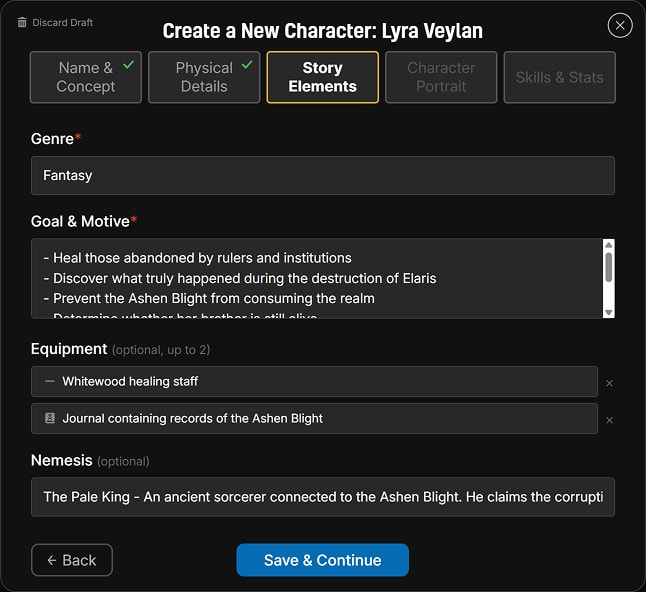
This is the step that quietly matters most. You define your character's goal or motivation, and optionally a nemesis: a rival or antagonist working against them.
If you have written OC backstories before, this is the same craft, pointed forward instead of backward. The story engine uses the goal to shape quests, escalate stakes, and build your character's tale toward a real climax. A vague goal ("become stronger") produces a wandering story. A concrete one ("find the sister who vanished with the caravan") produces momentum from scene one. The nemesis is optional but powerful: give the story a face to work against and it will use it.
Step 4: Their face, in style
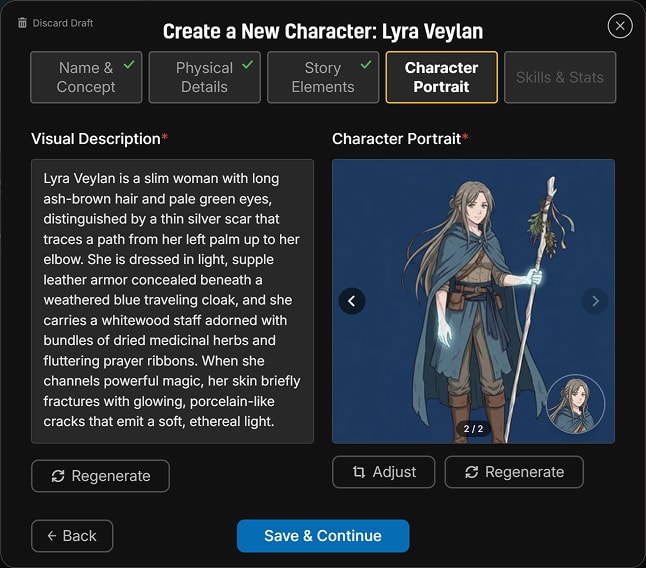
Here your OC gets a face. LiveTale generates a full portrait from everything you entered in steps 1 through 3, drawn in the game's signature illustrated style. Not quite right? Generate again: every version is kept, and you can flip between them with the arrows and pick your favorite.
Already have art of your character? Upload it instead, and adjust the crop so the framing sits exactly how you want. If you want your existing artwork turned into a playable hero in one step, see From Image to Hero, which covers that flow in detail.
This portrait follows your OC everywhere: the character sheet, their dialogue bubbles in every scene, and the cover of their tale if you ever share it.
Step 5: Light stats, so the dice can test them
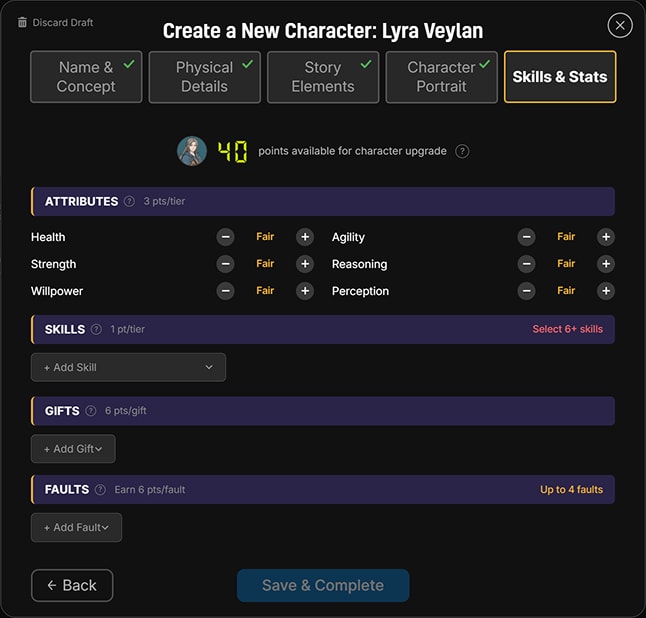
An OC you only describe can never fail, and a character who cannot fail cannot surprise you. So LiveTale gives your character light stats built on the Fudge system, which uses plain words instead of math. Your OC is not "Strength 16, +3 modifier." They are simply Good at Strength, Great at Swordplay, and honestly Poor at Reasoning. You spend a small point budget across:
- Attributes like Health, Strength, Willpower, Perception, and Reasoning.
- Skills suited to your genre, like Swordplay, Stealth, Arcana, or Persuasion.
- Gifts, special edges that do not sit on the ladder: Keen Senses, Innate Spellcasting, a Divine Blessing.
- Faults, meaningful weaknesses that make your character human. Taking a fault refunds points, so a flawed OC is also a more capable one.
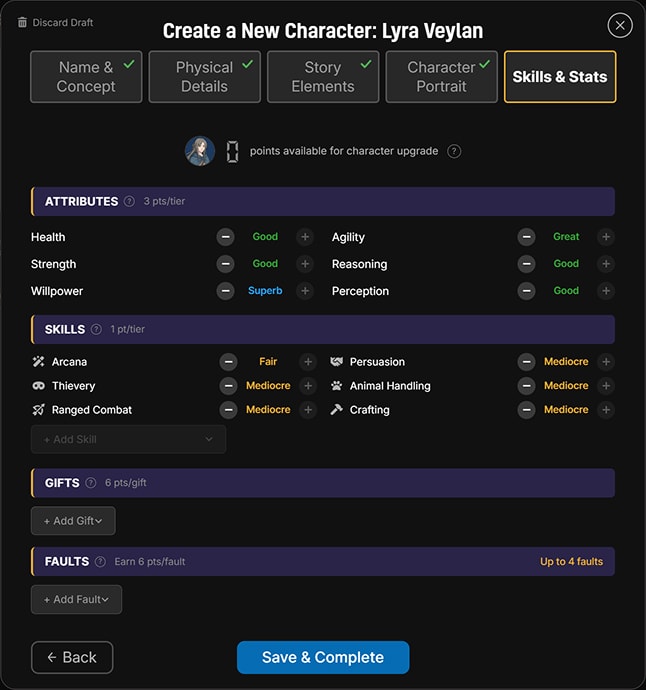
Two pieces of practical advice: do not leave Health and Strength at the bottom of the ladder (physical scrapes use them constantly, and the game will offer to allocate leftover points sensibly if you let it), and spike one signature skill. A character who is Great at one thing and Fair at the rest is more fun to play than one who is Good at everything.
Step 6: Full lore, in their Lore Book
Here is where LiveTale stops being a character creator and becomes a world tool. Every character has a Lore Book: four sections where you write the world they belong to, and everything you write is treated as authoritative by the storyteller.
- World & Rules: the setting's tone, rules, and truths. The kingdom of Veil where memory can be bought and sold. The high school where everyone is just slightly psychic.
- Characters: your OC's supporting cast, as itemized entries. Their mentor, their rival, their found family. Each entry can carry a pinned portrait you generate once and keep, so when that character walks into a scene, they have the face you gave them, every time.
- Locations: the places that matter, entry by entry.
- History and Events: what happened before scene one.
The Lore Book feeds the story everywhere: openings are seeded from your lore, scene directions cast your named characters and places, and the storyteller treats your world's facts as canon. If you build more than one OC in the same universe, you can copy a Lore Book between same-genre characters and keep one shared world across your whole cast. For a deeper tour, see the Lore Book guide.
Step 7: Roleplay them
This is the payoff no other OC maker has. Your character does not export to a PNG. They step into a scene.
An AI storyteller narrates and illustrates your OC's story, scene by scene, in the same art style as their portrait. You act and speak as your character; honest dice decide what happens when the outcome is uncertain, using exactly the attributes and skills you set in Step 5 (curious how? Here is how the dice work). Your lore's characters appear with their pinned faces. Quests emerge from your OC's goal, and the tale builds toward a real conclusion, chapter by chapter.
And when a story is finished, or just going gloriously well, you can share it as an illustrated tale page: your character's adventures, readable by anyone you send the link to.
Your character is waiting
That is the whole loop: concept, look, drives, a face, light stats, full lore, and then a story that takes all of it seriously. If you have a folder of OCs who have only ever existed as art and backstory docs, pick the one you love most, and give them somewhere to live.
If you have been roleplaying your OCs in AI Dungeon and are wondering how this compares, we wrote up the differences between AI Dungeon and LiveTale honestly, including which one fits which kind of player.