
Roll to Find Out: How Action Resolution Works with Fudge Dice
The heart of every solo RPG scene is the action roll. Here is how action resolution works in LiveTale with Fudge dice: how your AI Game Master picks the right skill, how the Fudge ladder rates it, and how four dice decide what happens next. No DnD math, no VTT to set up, no group required.
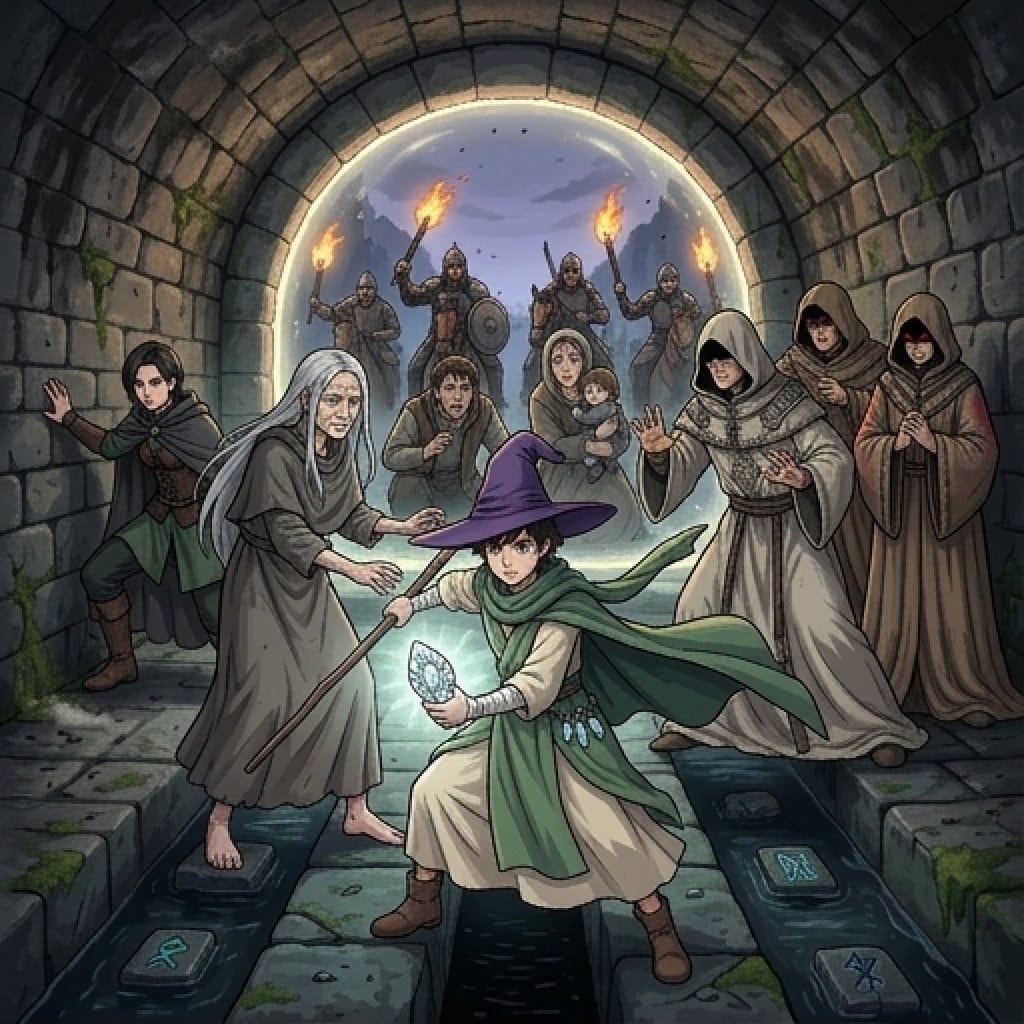
Your hero finally makes their move. Lyra raises her staff to shield a friend from the Inquisitor and hold the line. But in a real RPG, declaring an action is not the same as pulling it off. The action does not automatically take effect. It is time to roll the dice and test your hero's skill, and the stats you chose at character creation, your attributes and skills, decide the odds. This is action resolution, and it is the most important loop in the entire game.
What is action resolution in a solo RPG?
Action resolution is the moment a story game asks a simple question: does this work? You say what your character tries to do, the system sets the odds, dice are rolled, and the result feeds back into the fiction. Dungeons and Dragons does this with a d20 against a difficulty class. Fate and Ironsworn do it with their own dice and move tables. LiveTale does it with Fudge dice.
In a normal tabletop RPG, a Game Master judges your action, sets the difficulty, and narrates the outcome. In solo RPG play there is no GM at the table, so LiveTale's story engine plays that role for you. It reads what you wrote, chooses the fairest way to test it, rolls honest dice, and then narrates the consequences. No group to schedule, no virtual tabletop (VTT) like Roll20 or Foundry to configure, no rulebook to memorize. Just you, your hero, and the dice.
If you have not built a hero yet, start with our character creation guide. The attributes and skills you pick there are exactly what get tested here.
The skill test: your AI Game Master picks the trait
When you take an action, the first thing LiveTale does is decide which of your hero's traits the moment calls for. This is the skill test, and it happens automatically.
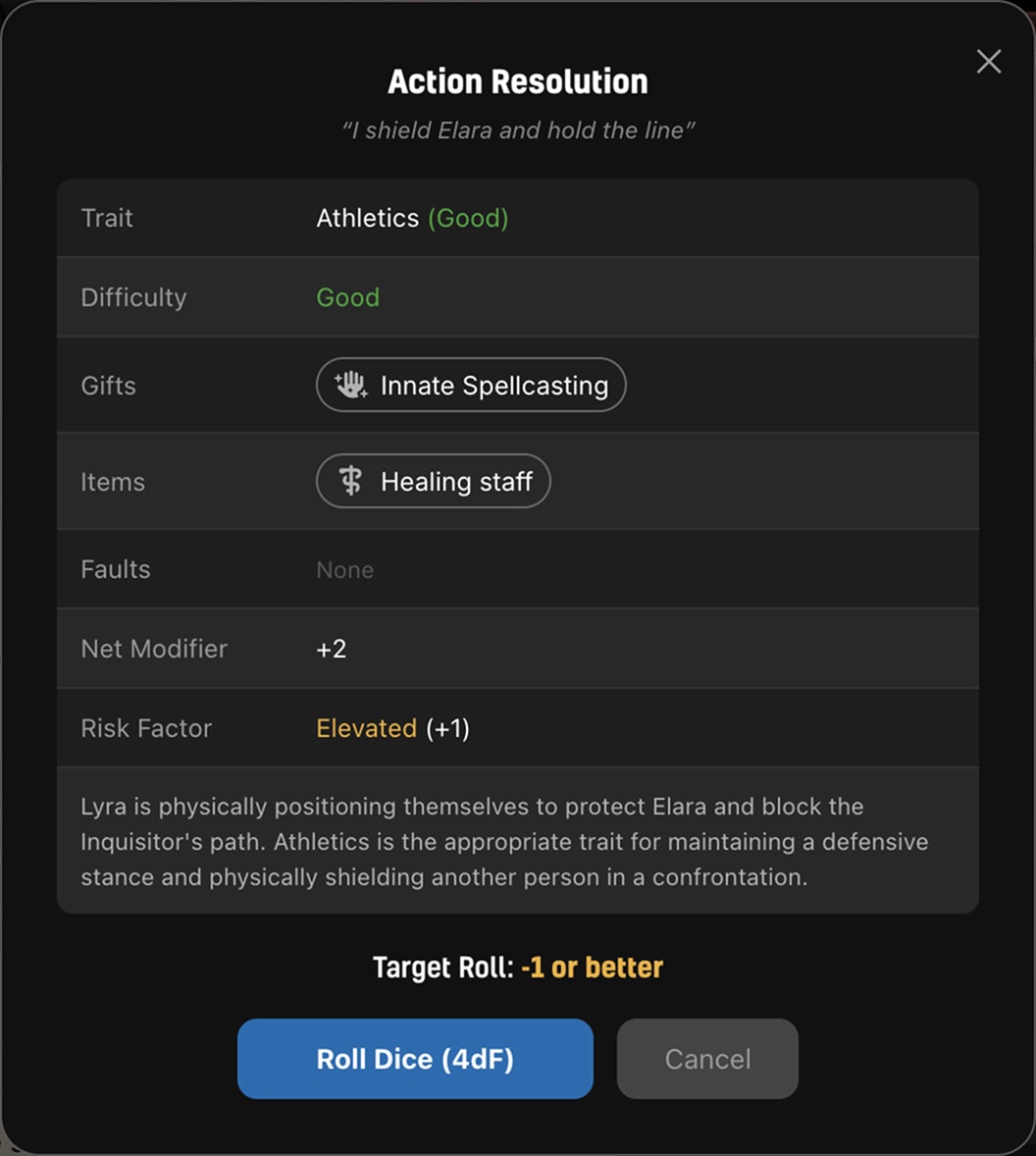
Here Lyra's action is "I shield Elara and hold the line." The story engine chose Athletics as the trait, because shielding someone and blocking a path is a physical, defensive move, and it tells you exactly why in the note at the bottom. That transparency matters: you can always see the reasoning, and if it picked the wrong trait, you are never locked in.
Notice that Athletics is rated Good, not "+2" or "15." That is the Fudge ladder, and it is what makes this system so friendly for solo play. Instead of numbers, every skill level is a plain word:
Terrible, Poor, Mediocre, Fair, Good, Great, Superb
Your hero is Good at Athletics the same way a person is good at cooking. The difficulty of the task sits on the exact same ladder. In this scene the difficulty is also Good, so hero and challenge are evenly matched before anything else is applied.
Then a few modifiers nudge the odds:
- Gifts and items help. Lyra's Innate Spellcasting gift and Healing staff combine into a Net Modifier of +2 in her favor.
- Faults hurt. A relevant weakness would push the odds the other way. Lyra has none here.
- Risk Factor sets the mood. LiveTale tracks story tension on a scale from Safe to Dangerous. This scene is Elevated (+1), so the world pushes back a little harder.
All of that resolves into one number at the bottom: Target Roll: -1 or better. That is the whole skill test in a single line. Because Lyra is skilled and well equipped, the dice only need to land at -1 or above for her to succeed. Do the math the engine does and it lines up: a Good difficulty raised by Elevated risk, minus her Good trait, minus her +2 of gifts and gear, leaves a target of -1. Her skill lowered the bar; the danger raised it a touch.
Rolling the Fudge dice
With the target set, it is time for the fun part. LiveTale rolls four Fudge dice, written as 4dF. These are the same dice the Fate RPG uses, and each one has six faces: two plus (+1), two blank (0), and two minus (-1).
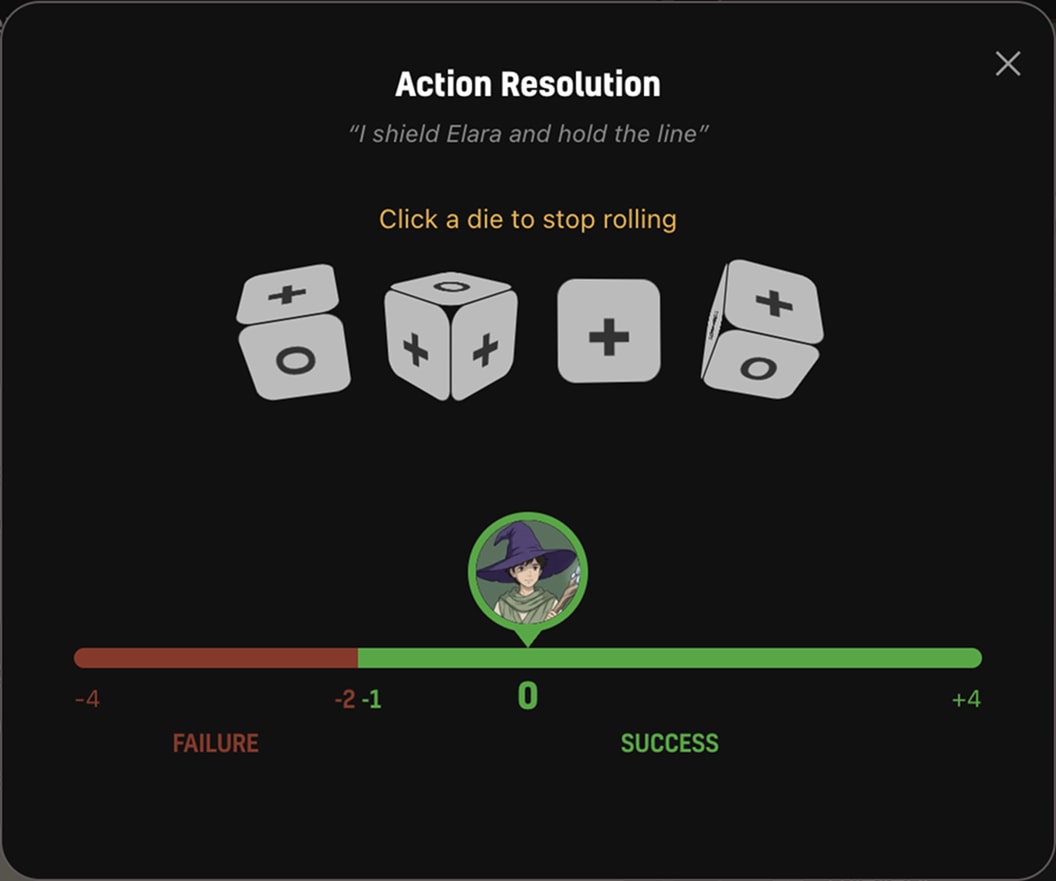
Add the four faces together and your roll lands somewhere between -4 and +4. Because most combinations cancel out, the result clusters around 0, exactly like the bell curve you would expect. Big swings are possible but rare, which keeps the game fair: your skill matters most, and the dice provide the drama on top.
The bar under the dice is the part players love. Your hero's portrait marks the target on a line that runs from -4 to +4. Everything from the target upward is green (success), everything below is red (failure). You do not need to remember any numbers. You just watch to see which side of the marker the dice land on.
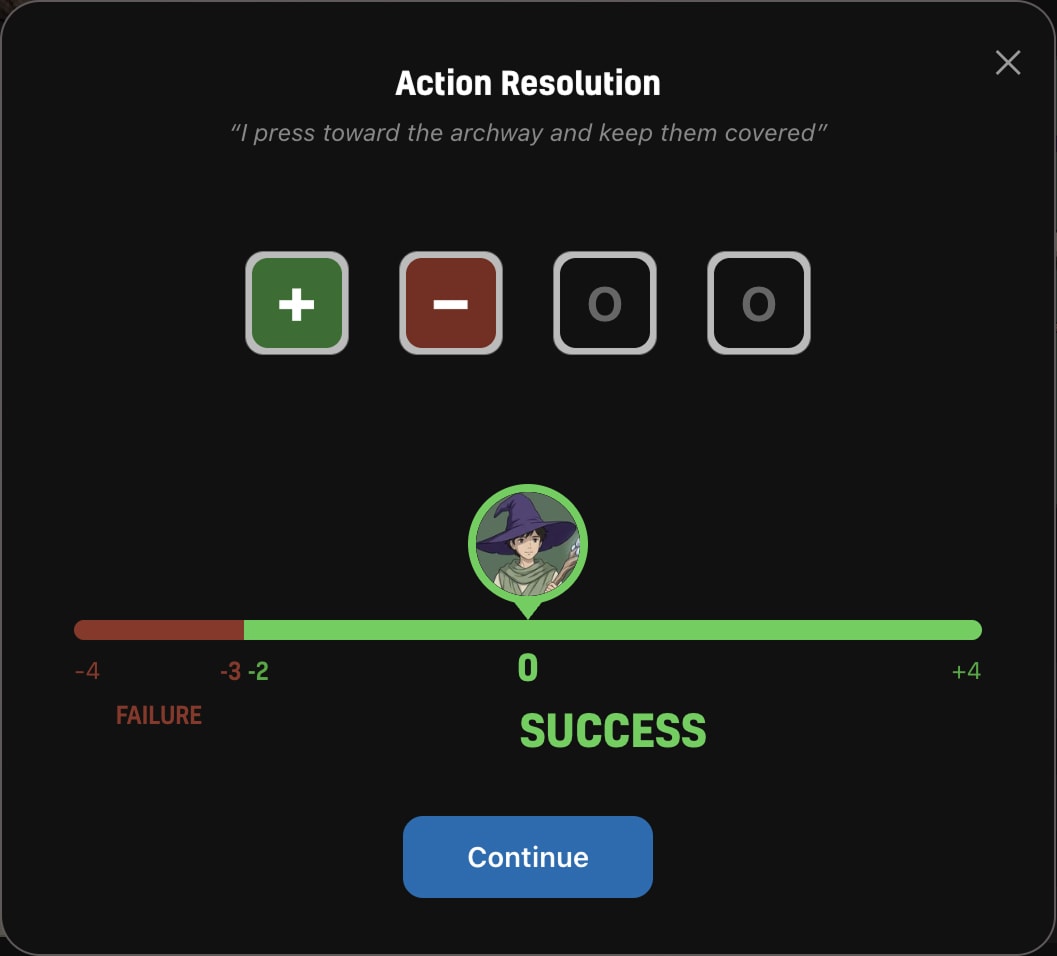
Meet or beat the target and your hero pulls it off. The further into the green you land, the more decisively it goes, and the storyteller narrates that degree: a strong roll is a clean triumph, a roll that just clears the line is a close-run thing.
And sometimes the dice say no.
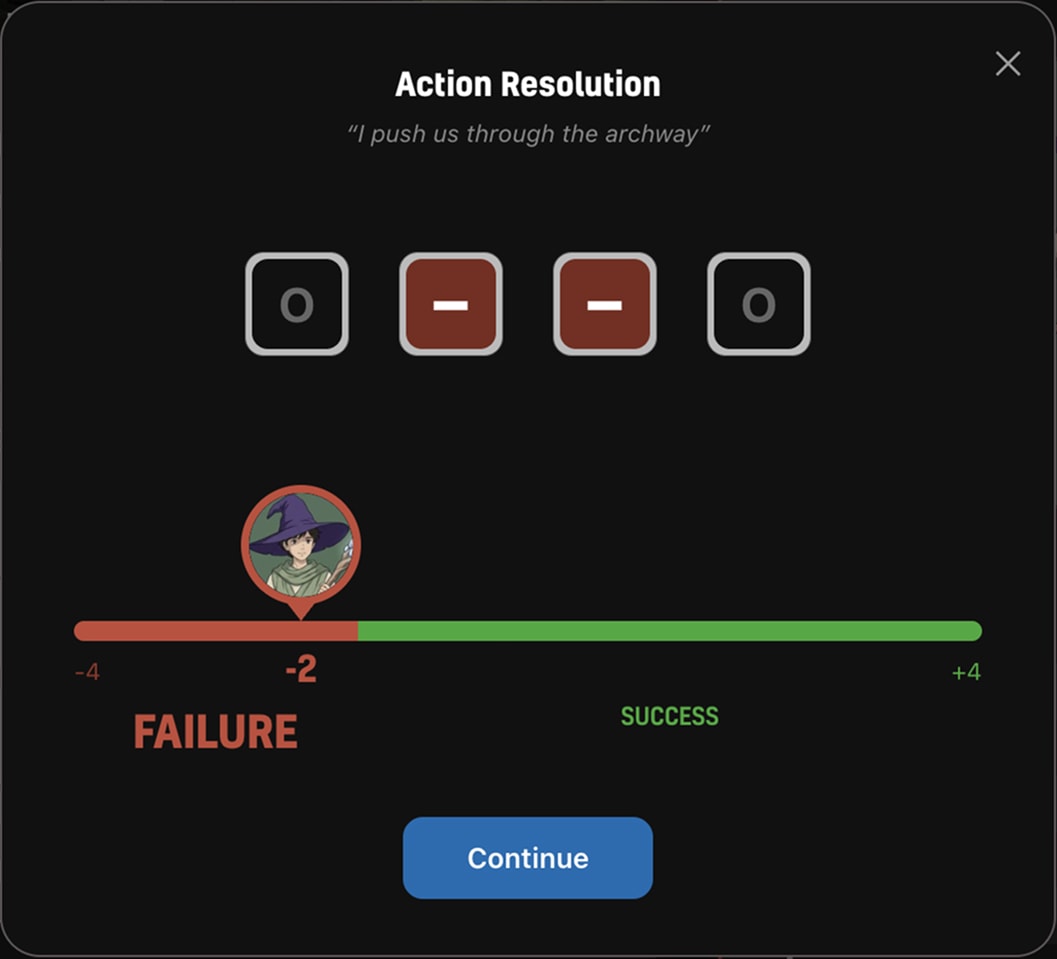
A failure is not a dead end. LiveTale's storyteller fails forward: instead of stopping your story, a missed roll turns into a complication, a cost, or a twist that pushes the scene somewhere new. The Inquisitor closes the gap, the archway holds you up, the plan needs rethinking. Your tale keeps moving either way. And if a result ever feels wrong, you can reroll or regenerate the beat rather than living with it.
Why Fudge dice make solo RPG better
Under the hood, this is the same "roll against a target" idea that powers DnD, Fate, and Ironsworn. What Fudge changes is the feel. There is no modifier arithmetic between you and the story, because the ladder is made of words, not numbers. There is no VTT to wrangle and no GM to wait on, because the engine sets the difficulty, rolls the dice, and narrates the outcome in one smooth step. You stay in the fiction the whole time.
That is the core loop of LiveTale, repeated scene after scene: you declare a move, your AI Game Master tests the right skill on the Fudge ladder, four dice decide, and the world responds. Simple enough to learn in one roll, deep enough to carry an entire solo RPG adventure.
Your hero is waiting to find out what they are made of. Create a character and make your first roll.