
Play Your Way: Story, Game and Challenge Modes
Game Settings now has three Play Modes. Write freely with no dice in Story, roll with a little help in Game, or risk your hero's life in Challenge for faster growth. Switch any time from the pill next to your Action tab.
Two messages reached us on the same day, and they asked for opposite things.
One player loves to write. To them, the dice and skill checks pulled attention away from the story they wanted to tell, and they asked for a way to go back to just the narrative. Another player told us LiveTale was too easy: the dice seemed to be on their side, even trying to die didn't work, and every adventure felt like a guaranteed win.
Both of them were right. People come to LiveTale for different things, so instead of picking one, we made it your choice. Game Settings now has three Play Modes: Story, Game and Challenge.

Story mode: write freely
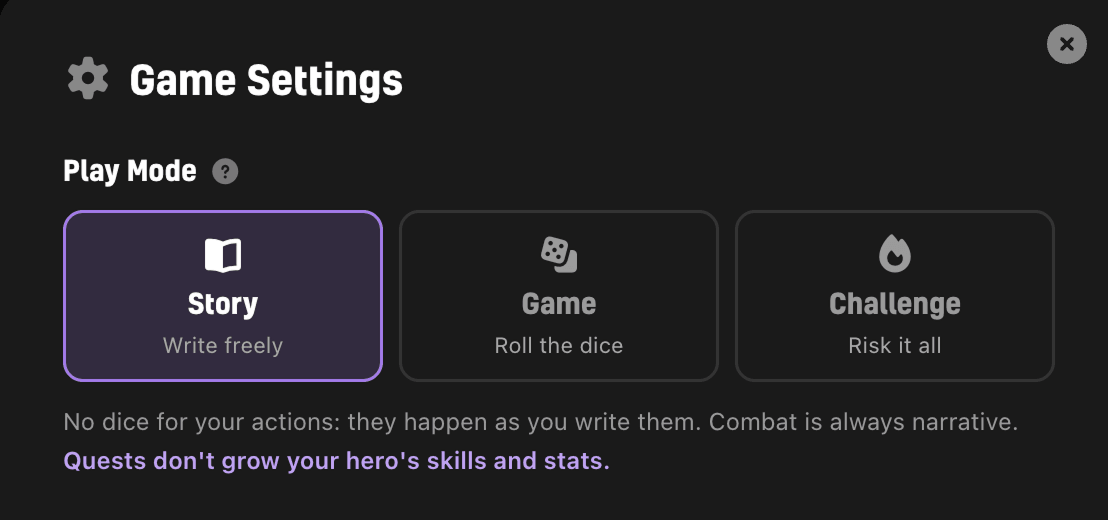
In Story mode there are no dice for your actions. Whatever you write, your hero does, and the storyteller shows how the world answers. If you write that your hero vaults the market stall and snatches the ledger, that is what happens.
Your hero is yours to write, but other people still have minds of their own. If you try to persuade the king, your hero makes the speech, and the king decides how to answer. When you want to set someone's reaction yourself, put it in parentheses as a Director's note, and the storyteller follows it.
A few things stay the same: the Oracle still rolls when you ask it a question, each action costs 1 Page as before, and anything the story itself gives your hero still counts. Combat is always narrative in Story mode, and your hero can't die.
There is one trade for that freedom: completing a quest in Story mode doesn't grow your hero's skills and stats. In the other modes, your hero earns those upgrades by rolling for them, so it wouldn't be fair to hand them out without a roll. For most writers this won't matter much. Your hero's story still grows with every scene.
Game mode: roll the dice
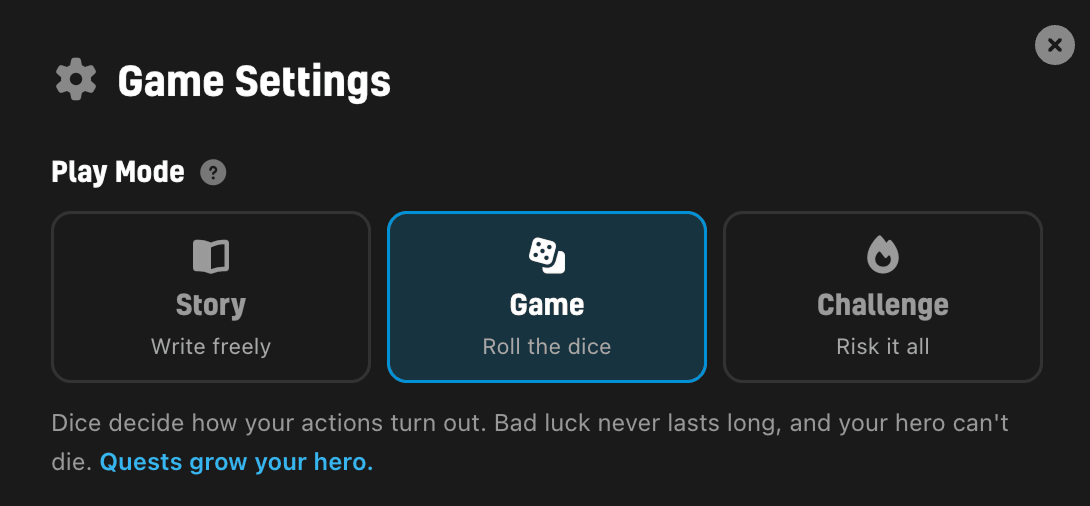
Game mode is LiveTale as you know it, and it stays the default. Dice decide how your actions turn out, using your hero's skills, gifts, faults and equipment. Game mode is on your side when luck turns. After a couple of failures in a row, the dice lean your way, and a reroll gets a small bonus. Your hero can't die, and quests grow your hero's skills and stats as before.
Challenge mode: risk it all
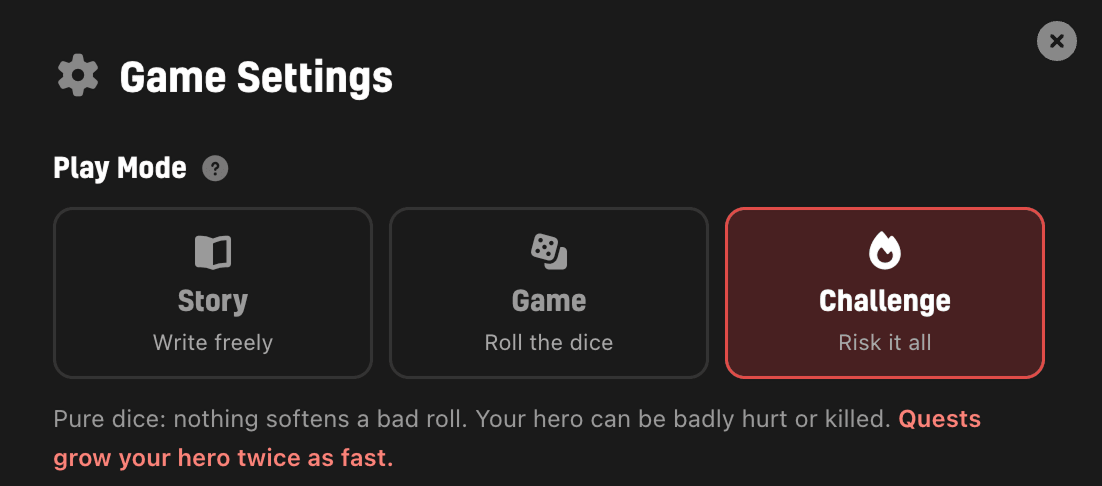
Challenge mode is for players who want the dice to really matter. Nothing softens a bad roll: no help after a losing streak, no bonus on a reroll, and your weaker skills roll at their true level. In mechanical combat, the early-scene protections are off too.
And your hero can die.
When an injury would drop your hero below Terrible Health, they go down, and you roll a Death roll: four dice, no modifiers, no reroll. Your chance to survive depends on the scene's Risk Factor, from about 94% in a Safe scene to 38% in a Dangerous one. Survive, and your hero wakes somewhere safe to recover. Fail, and your hero has fallen.
When your hero falls, you choose what happens next. You can rewind to the start of that scene and play it again, or end the tale there with a free epilogue. A tale that ends this way is marked Fallen. Only that tale ends: your hero keeps their sheet and can start new tales as always. The first scene of every tale is protected, so a hero who goes down there always survives.
Why take the risk? In Challenge mode, quests grow your hero twice as fast. Every rolled action counts double toward a quest's reward, so the skills and stats you fight for climb much quicker.
Check and switch your mode in one tap
You don't have to open the menu to see which mode you're in. A small pill next to the Action and Question tabs shows your current mode in its color: purple for Story, blue for Game, red for Challenge. On a computer, hover over it to read what the mode does. On a phone, it shows just the icon.

Click or tap the pill to open and switch. You can change modes any time, even in the middle of a tale. The new mode applies from your next action, and it applies to all your tales.
Try a scene in each mode and see which one fits the story you want to tell.